Why Material Choice Matters for Singapore Homes
Singapore's tropical climate presents unique challenges for custom furniture. Year-round humidity levels of 70–90%, frequent temperature fluctuations between air-conditioned interiors and humid outdoors, and limited ventilation in compact HDB and BTO flats all place stress on cabinet materials. The wrong choice can lead to warping, delamination, mould growth, or premature failure within just a few years.
When homeowners request quotations for custom furniture in Singapore, most focus on design, colour, and price. Material specification often receives less attention—yet it is the single biggest factor determining how long your wardrobes, kitchen cabinets, and TV consoles will last. Understanding the difference between laminate, plywood, and acrylic finishes helps you ask the right questions before confirming your order.
This guide breaks down each material in plain terms: what it is, how it performs in Singapore conditions, where it works best, and what it costs. We also cover the formaldehyde emission standards (E1, E0, ENF) that matter for indoor air quality, especially important for families with young children or elderly members.
- Singapore humidity (70–90%) stresses furniture materials year-round
- Material choice affects lifespan more than most homeowners realise
- Formaldehyde standards (E1, E0, ENF) impact indoor air quality
- Each material has specific strengths for different rooms and uses
- Understanding materials helps you compare quotations on a like-for-like basis
Laminate: The Workhorse of Singapore Carpentry
Laminate is the most common surface finish for custom furniture in Singapore. It is a thin decorative layer (typically 0.6–1.0 mm) bonded under heat and pressure to a substrate—usually plywood or particle board. The result is a hard, durable surface that resists scratches, stains, and fading. For HDB and condo kitchens, laminate is the default choice because it withstands daily cooking oil, moisture, and cleaning chemicals better than painted or veneered surfaces.
Laminate finishes come in an enormous range: matte, glossy, textured wood-grain, marble-look, concrete-look, and metallic effects. Anti-fingerprint matte laminates have become especially popular in Singapore BTO flats because they hide smudges and require less wiping. High-pressure laminate (HPL) offers superior durability compared to standard low-pressure laminate, making it worth the small premium for high-traffic areas like kitchen cabinets and shoe cabinets.
The downside of laminate is that it is a surface layer only. If the underlying substrate is poor-quality particle board, moisture can still seep through edges, joints, or damaged corners—causing swelling and delamination. In Singapore's humid climate, always insist that laminate-finished cabinets use plywood (not particle board) as the carcass material, and that all exposed edges are properly sealed with PVC edge banding.
- Laminate is the most widely used surface finish in Singapore custom furniture
- Resists scratches, stains, fading and cleaning chemicals—ideal for kitchens
- Available in matte, gloss, wood-grain, marble-look and textured finishes
- Anti-fingerprint matte laminates are popular for BTO and condo homes
- Always pair laminate with plywood substrate and sealed edge banding
Plywood: The Structural Foundation That Lasts
Plywood is an engineered wood product made by gluing together thin layers (veneers) of wood with alternating grain directions. This cross-grain construction gives plywood exceptional strength, dimensional stability, and resistance to warping—qualities that make it the preferred carcass material for quality custom furniture in Singapore. Unlike particle board or MDF, which are made from compressed wood fibres, plywood retains its structural integrity even when exposed to moderate moisture.
For Singapore homeowners, the most important plywood consideration is the formaldehyde emission standard. E1-grade plywood (≤0.124 mg/m³) is the legal minimum and is safe for most homes. E0-grade (≤0.050 mg/m³) offers lower emissions and is a sensible middle-ground upgrade. ENF-grade plywood (≤0.025 mg/m³) is the strictest standard available—effectively formaldehyde-free—and is strongly recommended for families with babies, young children, or members with respiratory sensitivities. ENF plywood costs 15–25% more than E1, but the peace of mind is worth it for bedrooms and enclosed spaces.
Plywood carcasses are the industry standard for high-quality custom wardrobes, kitchen cabinets, and TV consoles in Singapore. They hold screws and hardware better than particle board, resist sagging under heavy loads (important for full-height wardrobes), and tolerate the stress of repeated opening and closing. When a supplier quotes you for 'plywood cabinet', always clarify whether they mean full plywood carcass with plywood backing, or just plywood doors with a cheaper substrate inside.
- Plywood offers superior strength, stability and moisture resistance vs particle board
- Formaldehyde standards: E1 (minimum), E0 (low emission), ENF (ultra-low, recommended for families)
- ENF plywood costs 15–25% more but is the safest choice for bedrooms
- Plywood holds screws and hardware better, resisting sagging in tall cabinets
- Always clarify whether 'plywood cabinet' means full plywood carcass or just doors
Acrylic: Premium Gloss and Modern Aesthetics
Acrylic is a high-gloss surface material that creates a mirror-like, reflective finish on cabinet doors and panels. It is significantly more expensive than laminate—typically 40–60% more per square foot—and is chosen primarily for its luxurious appearance rather than its functional superiority. In Singapore, acrylic finishes are most commonly seen in modern condo interiors, designer showflats, and high-end kitchen renovations where aesthetics are the top priority.
The visual impact of acrylic is undeniable. Colours appear deeper and more saturated, and the reflective surface makes small spaces feel larger and brighter—an advantage in compact Singapore HDB flats. However, acrylic surfaces are less forgiving than laminate. They show fingerprints, dust, and smudges readily, and even soft cloths can leave micro-scratches if not cleaned properly. For families with young children or busy kitchens, the maintenance overhead is a genuine consideration.
Acrylic is usually applied as a door or panel finish over a plywood or MDF substrate, not as a structural material itself. It is not inherently more durable than high-quality laminate—in fact, it can chip or crack on impact more easily than HPL laminate. For Singapore homeowners on a budget, a practical compromise is to use acrylic selectively: on kitchen island panels, wardrobe doors in the master bedroom, or a single feature wall, while using quality laminate elsewhere. This delivers the premium look without the full premium price.
- Acrylic provides a mirror-like, high-gloss finish unmatched by laminate
- Costs 40–60% more than laminate—chosen for aesthetics, not function
- Shows fingerprints, dust and scratches more readily than matte surfaces
- Best suited for condos, showflats, and selective feature applications
- Consider using acrylic selectively with laminate elsewhere to manage budget
Choosing the Right Material for Each Room in Your Singapore Home
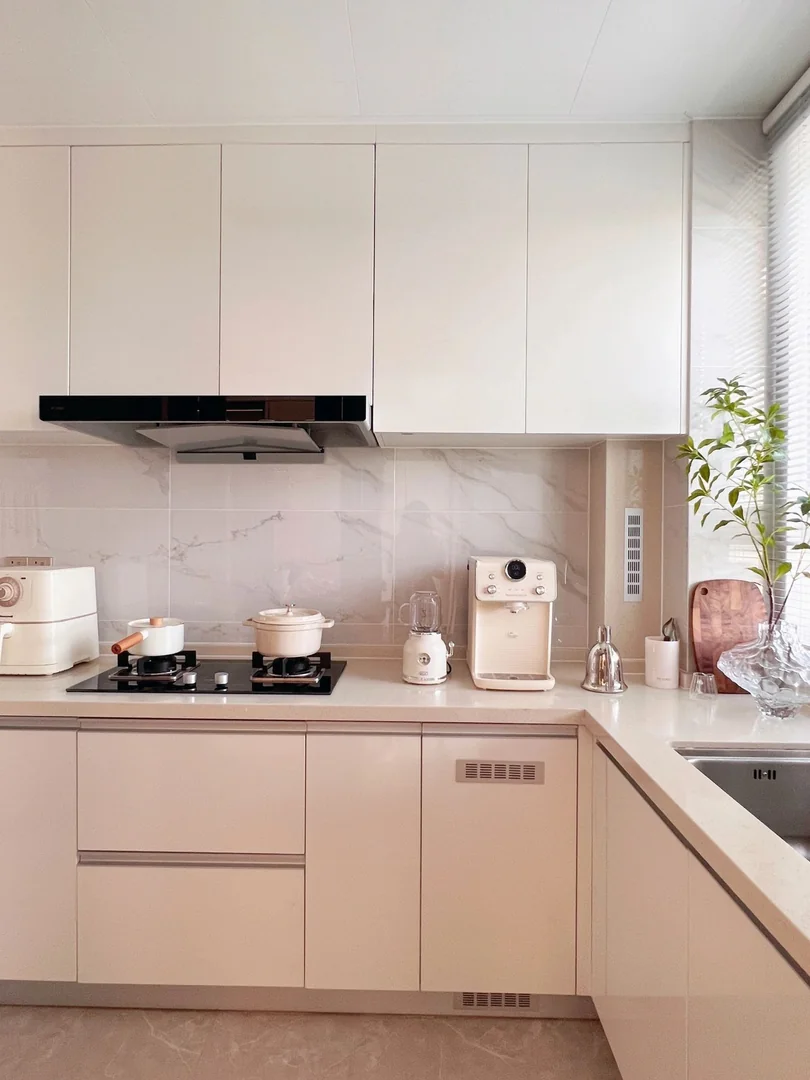
Kitchen cabinets face the toughest conditions: heat, steam, oil splatter, and frequent cleaning. For Singapore HDB and condo kitchens, the recommended combination is an ENF or E0 plywood carcass with high-pressure laminate (HPL) doors and drawer fronts. This delivers durability, moisture resistance, and safe indoor air quality where you cook and eat. Avoid particle board in kitchens—it swells rapidly when moisture penetrates edges or joints.
Wardrobes in bedrooms should prioritise indoor air quality since you spend 6–8 hours daily breathing the air in this room. ENF plywood carcass with laminate or wood-veneer doors is the sweet spot. If budget allows, upgrade to soft-closing hinges and drawer systems (Hettich, Häfele, or Blum) to reduce wear and noise. Full-height wardrobes place significant load on the carcass—another reason plywood outperforms particle board over time.
TV consoles, feature walls, and display cabinets can use E1 or E0 plywood with laminate finishes in most cases. These areas are not exposed to cooking conditions, so the material demands are lower. If you want a statement piece, consider acrylic doors on the TV feature wall or a single display cabinet while keeping the rest in laminate.
Shoe cabinets and entryway storage should use moisture-resistant materials because shoes bring in rain and humidity. A plywood carcass with laminate finish and proper ventilation gaps is the practical choice. Avoid materials that trap moisture, which leads to mould and odour problems common in Singapore foyers.
Glee Deco & Furniture offers material consultation as part of our custom furniture service for Singapore homes. We explain the differences between E1, E0, and ENF plywood, show laminate samples in person, and help you allocate your budget across rooms based on actual usage conditions. Send your floor plan via WhatsApp to +65 8742 6767 for a free quotation and material recommendation tailored to your home.
- Kitchen: ENF/E0 plywood carcass + HPL laminate for heat, steam and oil resistance
- Bedroom wardrobe: ENF plywood + laminate doors for best indoor air quality
- TV console: E1/E0 plywood with laminate; acrylic optional for feature accents
- Shoe cabinet: plywood + laminate with ventilation gaps to manage moisture
- WhatsApp your floor plan to +65 8742 6767 for material-specific advice and quote